Escorted Tours
Upon arrival in Kathmandu, you will be greeted and assisted by our representative and transferred to the hotel for check-in. Kathmandu is surrounded by four hills, Fulchowki, Chandragiri, Shivapuri and Nagarjun. Kathmandu Valley has three major cities, Kathmandu, Bhaktapur and Patan. Prior to Nepal's unification in the 18th Century, these three cities were sovereign states that were ruled by the Malla Kings. The Capital City of Nepal, Kathmandu is located at an altitude of 1,400 metres above sea level and is home to seven UNESCO World Heritage Sites such as Kathmandu Durbar Square, Bhaktapur Durbar Square, Patan Durbar Square, Pashupatinath Temple, Changu Narayan Temple, Swayambhunath Stupa and Baudhanath Stupa. Today, we will collect the passport copies and Chinese Visa forms to apply for a Tibet Travel Permit and Visa. Your original passport and the Chinese form must be handed over to the visa officer before 12:00pm today. You will need to arrive in Kathmandu by 10:00am to ensure you have enough time to file the paperwork.
After breakfast, enjoy a sightseeing tour of Kathmandu. Visit Durbar Square, which used to be the Palace of the Kings, as well as several buildings with unique architecture, monuments and Temples are found here. The most important Temple to visit here is the Kumari Bahal or the Temple of the Living Goddess. The worship of the Goddess as a young girl represents the worship of divine consciousness spread all over the creations. The complex also includes an idol of Kal Bhairava, the image of Bhairav, which represents Lord Shiva in his destructive manifestation. The Kal Bhairav is one of the most famous, of all the Bhairavs in Kathmandu and the most remarkable fact about this icon is that it was made from just one rock. Next, visit Swayambhunath. Located at a distance of approx. 3 kms from the centre of Kathmandu, this Buddhist Stupa is said to be 2,000 years old. This Stupa is composed of a solid hemisphere of brick and earth, which supports a lofty conical spire capped by a pinnacle of gilt copper. Painted on a four sided base, below the spire are the all seeing eyes of Lord Buddha. The whole area around the Stupa contains an array of small Stupas and Temples. As it is situated on the small hillock, it is considered one of the best places to view Kathmandu Valley. Meals: Breakfast
Start Planning Today
Our travel specialists are ready to design the perfect itinerary for you: whether it's your first time or your fifteenth.
Mon–Fri 09:00am–17:00pm AEST · No obligation · Free expert advice
After breakfast, we join a sightseeing tour of Patan, Durbar Square, Pashupatinath and Boudhanath. Patan Durbar Square is located about 5 kms south of Kathmandu in the Kathmandu Valley, on the Southern side of the Bagmati River. Patan is one of 3 Royal Cities in the valley. A destination for connoisseurs of fine arts, Patan is filled with wood and stone carvings, metal statues, ornate architecture including dozens of Buddhist and Hindu Temples and over 1,200 monuments. The City of Patan is believed to have been built in the 3rd Century B.C. by the Kirat Dynasty. It was expanded by Lichhavis in the 6th Century A.D. and again by the Mallas in the Medieval Period. Durbar Square, like its counterpart in Kathmandu, is an enchanting mélange of Palace buildings, artistic courtyards and graceful Pagoda Temples. Listed as a World Heritage Site, the former Royal Palace Complex is the centre of Patan's religious and social life and houses a Museum containing an array of bronze statues and religious objects. Next, we visit Pashupatinath Temple. Dating back to 400 A.D., Pashupatinath Temple is one of the oldest Hindu Temples dedicated to Lord Shiva. It is, for the Hindus, what Mecca is for the Muslims. Situated amidst a lush green natural setting on the bank of the sacred Bagmati River, the Temple built in the Pagoda Style with a gilded roof and richly carved silver doors. Pashupatinath is the centre of the annual Pilgrimage on the day of Shivaratri, which falls in February/March. You will also be able to see the cremation grounds that lie on the bank of Bagmati behind the Temple. Boudhanath Stupa is one of the oldest and the biggest Buddhist Monuments ever built in Nepal and is one of the holiest structures imposing a height of 36 metres with 3 massive Mandala style platforms. It is surrounded by colourful buildings housing families creating a friendly enclosure. The Stupa is visited every year by tens of thousands of pilgrims from all over the world. Meals: Breakfast
After breakfast, we drive to Syabrubesi, which is a naturally magnificent village situated in Langtang National Park and a renowned trekking trail in Nepal. Located near the eastern part of the Trishuli River, Syabrubesi serves as the gateway to the Langtang Valley. This charming village is only 126 kilometres from Kathmandu and is easily accessible by road. Later, you can choose to explore the village, taking in its stunning natural beauty and experiencing the local culture. Meals: Breakfast
After breakfast, we drive 2-3 kms to the Nepal-China Border. On the Nepal side, it is known as Rasuwagadhi and on the China side, it is known as Gyirong. At the border, you will be met by your guide. Gyirong is surrounded by lofty snow-capped mountains and dense forests. Gyirong Port is the only operational Nepal-Tibet border crossing for tourists. Upon arrival in Gyirong, check-in at the hotel for your overnight stay. In the afternoon, take a stroll to visit the Paba Temple, a Gelugpa Temple built by the Tibetan King Songtsan Gambo at the proposal of his wife, Nepali Princess Bhrikuti. The Nepali-style Temple, with its delicate murals, is only a few minutes' walk from your hotel. Meals: Breakfast
After breakfast, begin your journey to Shegar (New Tingri), driving approximately 380 kms, which will take about 6-7 hours. En route, you will pass the sacred Cave of Milarepa and a revered Yogi from the 11th Century. Continue your drive through the Gongthang La Pass, which sits at an elevation of over 5,000 metres. Proceed alongside Pekutso Lake and then onwards towards Old Tingri, which is approximately 100 kilometres from Pekutso Lake. The journey offers stunning scenery with the Shishapangma Snow Mountain on your right and the Pekutso Lake on your left. On a clear day, you may even catch a glimpse of Mount Everest along the way. Continue driving along the Friendship Highway and after about an hour, you will arrive in Shegar. Check-in at the hotel, the remainder of the day is at leisure. Meals: Breakfast
Today, we travel to the beautiful City of Shigatse. The journey takes you over the famous Gawu La Pass, at an elevation of 5,198 metres, offering stunning views of the four highest peaks in the world, Mt. Everest at 8,848 metres, Mt. Lhotse at 8,516 metres, Mt. Cho Oyu at 8,201 metres and Mt. Makalu at 8,463 metres. The view from this pass is truly spectacular, especially if weather conditions are favourable. Upon arrival in Shigatse, check-in at the hotel. This evening, visit the Tashilunpo Monastery, the seat of the Panchen Lama and one of the most important Monasteries in Tibet. Founded in 1447 by the first Dalai Lama, Gyalwa Gedun Drupa, Tashilunpo Monastery has become one of the most vibrant Monasteries in the U-Tsang Province of Tibet. Meals: Breakfast
After breakfast, we drive 90 kilometres to Gyantse. Gyantse is an ancient town situated between Shigatse and Lhasa, positioned on the trade routes connecting Lhasa to the East, Shigatse to the West and India to the South. It is known for its significant cultural and historical sites. In Gyantse, we visit the Gyantse Kumbum, a remarkable Chörten commissioned by a Gyantse Prince in 1427. This 35 metre high structure, with its white tiers adorned with decorative stripes and crowned by a golden dome, is truly awe inspiring. You will also have the opportunity to explore the authentic Tibetan Town of Gyantse. In the afternoon, we continue on to Lhasa. Along the way, pass over the Karo La Pass and the Kambala Pass. Enjoy views of the beautiful Karo La Glacier, Yamdrok Lake and the Brahmaputra River before reaching Lhasa. Upon arrival in Lhasa, transfer to your hotel for check-in. Meals: Breakfast
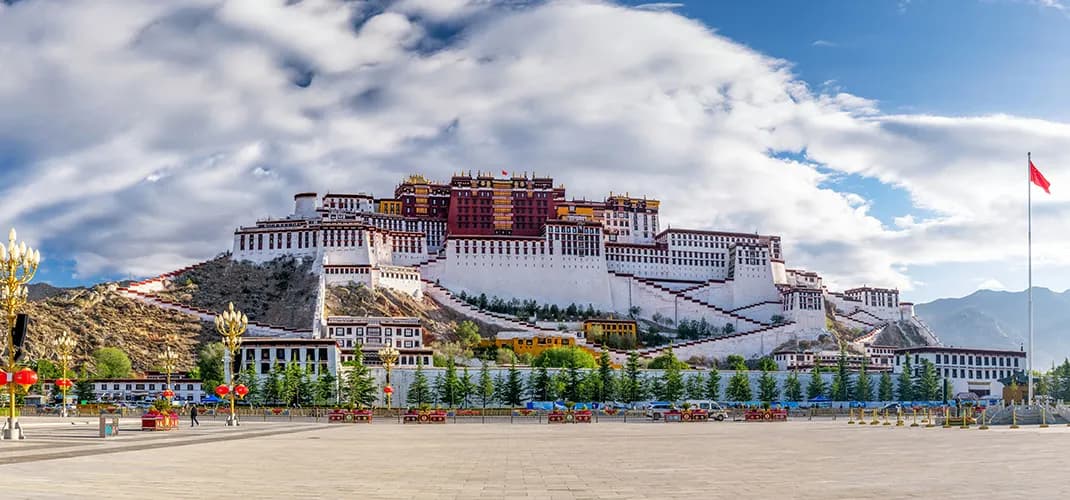
After breakfast, we enjoy a sightseeing tour of Lhasa. See Potala Palace, which was built in 1645 by the fifth Dalai Lama. Potala Palace is the highest Ancient Palace in the world with its highest point reaching 3,750 metres above sea level. Towering at 100 metres above Lhasa, this 13 storey Palace encompasses over 1,000 rooms and covers 13 hectares (32 acres). It serves as a Grand Estate and a symbol of Tibetan heritage, drawing thousands of Pilgrims annually. (Due to visitor limitations, the order of sightseeing may be adjusted by your guide). Jokhang Temple was constructed in the 7th Century by Songtsan Gambo and is the spiritual centre of Tibet and the holiest site for Tibetan Pilgrims. Originally known as 'Tsuklakang' (Tsulag Khang), meaning 'House of Religious Science' or 'House of Wisdom', this 4 storey building features roofs covered with gilded bronze tiles. Its architecture combines Han, Tibetan, Indian and Nepalese styles, reflecting a Mandala world outlook of Buddhism. Jokhang Temple, along with Potala Palace and Norbulingka, is listed as a World Cultural Heritage Site. Around the Temple, explore Barkhor Street where you can participate in kora (a religious circumambulation) with Pilgrims and locals and explore the Old Market. Meals: Breakfast
After breakfast, we visit Drepung Monastery, which is located at the foot of Gambo Utse Mountain approximately 5 kilometres from Downtown Lhasa. Drepung Monastery is one of the largest Tibetan Monasteries and one of the Great Three Gelug Monasteries, alongside Sera and Ganden. From a distance, it resembles a heap of rice, which is reflected in its name, meaning 'collecting rice'. As the largest and most significant Monastery in the Gelug School of Tibetan Buddhism, Drepung Monastery was home to around 7,700 Monks at its peak. Spread across the lower hillside of Mount Gambo Utse, its stunning white buildings contrast beautifully with the rugged mountain landscape. Next, we visit Sera Monastery, which is one of the six main Gelugpa Monasteries of Tibetan Buddhism and also serves as a prominent religious educational institution. Originally built in 1419 by Jamchen Chojey Sakya Yeshe, a disciple of Je Tsongkhapa, it is renowned for its vibrant educational activities. Experience the soothing chanting of Buddhist scriptures in the Tsochin Hall and observe the traditional Buddhist debating in the large debating courtyard. Admire the thousands of murals adorning the Monastery's walls and explore the library and printing press to gain a comprehensive understanding of its history and significance. Meals: Breakfast
After breakfast, you will be transferred to Lhasa Airport to board a flight for Kathmandu (Flight under own arrangements). Upon arrival in Kathmandu, transfer to your hotel for check-in. The remainder of the day is at leisure. Meals: Breakfast
After breakfast, transfer to the Airport for your flight to your onward destination or back home. Meals: Breakfast
Tour Prices are per person twin share in Australian Dollars. Conditions apply and group tours are subject to change and availability. Prices are subject to currency fluctuations. (iat)